Showing posts with label peer instruction. Show all posts

Friday, May 15, 2015

#twitterquiz: an educational experiment

I recently came across this tweet which makes very innovative use of pictures to ask a multiple choice question.  After some experimentation I made this quiz yesterday


So far, the tweet has received 2,568 impressions and 741 engagements, which is twitter-speak for number of people who saw the tweet and clicked on it, respectively.  This is in large parts thanks to retweets by RealTimeChem, A-Level Chemistry and EiC, each with several thousand followers.

The question is taken straight from my teaching material and 741 is far more students that I reach in a year of teaching at the University of Copenhagen.  Did I just teach my first (Nano)MOCC?

Anyway, since I use peer instruction in all my courses I have tons more questions so this won't be the last #twitterquiz I post.

If you would like to make your own #twitterquiz you can find the images here.


This work is licensed under a Creative Commons Attribution 4.0

Sunday, May 10, 2015

Python peer instruction questions


I am teaching a molecular simulations/intro to python course and have just finished drafting the last sets of peer instruction questions. Here's the last question. The idea is that they have to write a small python program on the spot but this might be more of a take home question.  Can you do it?

I'm not always this "evil".  Here's a more typical one.


This work is licensed under a Creative Commons Attribution 4.0  

Sunday, November 17, 2013

Taking my thermodynamics course online


Readers of this blog will know I occasionally dabble with the flipped classroom/peer instruction approach in my teaching, and this year I finally went whole hog - to use an Iowan expression.

What I did (tl;dr)
This year I abandoned the textbook for my part of the course and replaced the material with videos and Powerpoint slides.  This allowed me to completely change the order I taught subjects in and introduce more of what I think are more relevant subjects.

Why I did it
Last year I had already flipped the classroom and used lecture periods almost exclusively on peer instruction questions based on the assigned reading.  Now that I was finally happy with how I was teaching, I started to realize that I was less happy with what I was teaching.

What one is teaching, and the order it is being taught in, is to a large extent dictated by the textbook one chooses.  We chose Dill's Molecular Driving Forces. Like most textbooks it's written for the instructor rather than the students: an excellent resource for people who already understand the subject.  And why not?  I am the customer after all.

Thermodynamics/statistical mechanics books are essentially physics books that go through the definition and derivation of key equations and concepts first and in great detail and treat the applications as more of an afterthought.  Example: I would argue that $K=e^{-\Delta G^\circ/RT}$ is a more useful equation than, say, $S=q_{rev}/T$ for the practicing chemist, yet most books will spend many more pages discussing the latter. And don't get me started on the Carnot cycle.

Redesigning the curriculum I had five guiding principles in mind:

1. The video shown at the beginning of this post.
2. Start with the most useful (a much less arbitrary term than important) topics to my students.
3. Let the homework problems dictate the material, not the other way around.
4. Reduce the load and spend more time on what you consider most useful.
5. Study test test test – test.

So, one of the first homework questions I wrote involves computing $\Delta G^\circ$ from a binding curve.  Then I wrote the corresponding lecture notes.  Since I introduced this topic early, I also get to use it again and again during the rest of the course, which increases retention.

Similarly, I was able to introduce problems involving the Molecular Calculator, because I could taylor the lectures accordingly.

How I did it
1.  The homework problems.  I rewrote all the homework problems from scratch. It's hard to describe how liberating (and relatively easy) it is to write exactly the problems you want knowing that everything you need by definition will be covered in lecture, exactly how you want it.

As in previous years I put the answer up in form of multiple choice on PeerWise.  Once an answer is selected the solution (copied from my Maple solution) is revealed.  Occasionally, I also supplied intermediate solutions to help guide the student and screen-casts showing how I solve the problem using Maple.

Finally, I the students some choice in the problems they want to solve.  For example, I told them they had to solve any six out of nine questions.  I made sure that the first six were relatively easy, but some of the remaining questions could be quite tricky.  Many students did all of them, and I got few complaints about the most difficult ones since the students themselves had chosen to work on them.

You can find the problem sets here.

2. The video-lectures.  I chose to make video-lectures because it was the fastest way to generate material.  The Powerpoint slides contain mainly equations and pictures and all the explanation is done verbally (remember: the students can rewind and repeat).  This is much quicker than writing everything down in detailed lecture notes.

I make normal Powerpoint slides and use ScreenFlow to record (PC users can use Camtasia). Another option would have been pen-casting but many of the figures were much too complicated to sketch and screen-casting made it easier to introduce videos, simulations, etc. However, if you have handwritten lecture notes you are happy with, this could be a good option.

Each video lecture is quite short (max 10 minutes) and most end with a question. I provide the Powerpoint slides - except the ones containing the answer - along with the videos.  The students have to watch between four and six videos before each two-hour "lecture" period

The editing features in ScreenFlow make it relatively easy to correct mistakes.  If you remember to pause briefly (also verbally) between each slide, then you only have to repeat one slides worth of material.

You can see the videos and slides here

3. "Reading"-quiz.  The students have to take an on-line quiz (no points) the evening before the day of the lecture (at the latest): one question per video that can be easily answered if one has watched the video (often a T/F question).  I do this for two reasons: (1) to make it clear that they must prepare for class since I am not going to repeat the material and (2) that they should pay attention while watching the videos.   The last question on each quiz is whether I should discuss something in more detail in class.

4. The "lecture" period.  During the 2 x 45 min "lecture" period I ask roughly 20 peer instruction questions.  Roughly ten are review questions on previous material and the remaining questions are on the new material.  I use Socrative for voting.  Most are conceptual questions designed with discussion in mind.  

What I learned so far
1. Making the slides and videos and questions is a lot of work.  Even considering I have taught this course many times and knew exactly what I wanted to do.  But ...

2. ... it is much, much faster than writing a textbook yourself. Constructing such a textbook-replacement for your course is a manageable task. And extremely liberating and satisfying.

3. We live in the age of Google (OK, I kinda knew this one already).  You don't need to include a table of dielectric constants or heats of formation in your teaching material.  Just give a few examples of finding this info with Google in one of the early videos.

4. Review is essential.  The data from in-class voting is clear: take a question that 95% of the class answered correctly and ask is a week later.  Half the class will get it wrong.  Research shows that many subject must be reviewed at least 3 times before it sticks.  Keep this in mind when designing your curriculum.  Most courses pack in way too much material.  Very little of it sticks.  See the video at the beginning of the post again.

5. Surprisingly (to me) many of the students take the "reading quiz" at the very last minute and probably wouldn't prepare for class if it wasn't for the reading quiz.

Example: 30 students took the exam.  For the September 30 lecture period, 24 students completed the "reading"-quiz.  Eight of them completed the quiz between 11 pm and midnight (the deadline).

OK. That's it, for now.  Now would be a good time to watch the video a third time.  You know, so it sticks.

More posts one statistical mechanics can be found here.

Creative Commons License
This work is licensed under a Creative Commons Attribution 3.0 Unported License

Thursday, April 25, 2013

The entropy increases when things fall apart

The translational entropy dominates when bonds are broken
An entropy change has four contributions$$\Delta S^\circ=\Delta S^{Molecular}+\Delta S^{\circ,Translation}+\Delta S^{Rotation}+\Delta S^{Vibration}$$For reactions where bonds are broken $S^{\circ,Translation}$ usually dominates.

For example for the reaction $H_2 \rightarrow 2H$ the entropy changes at 25 $^\circ$C are:$$\Delta S^\circ = 11.6+100.1-12.8-0.0=98.9 \text{ J/molK}$$For breaking the hydrogen bond between two water molecules, $H_2O\cdot \cdot \cdot HOH\rightarrow 2H_2O$, the free energy energy contributions are$$\Delta S^\circ =0.0+136.2+9.3-66.0=79.4  \text{ J/molK}$$In both cases $\Delta S^\circ$ is positive because two particles have more entropy than one.

In many cases $\Delta S^\circ \approx \Delta S^{\circ,Translation}$ is a reasonable approximation.

Test: What happens to the standard entropy for this process


Sunday, January 27, 2013

Tuesday, January 1, 2013

The enthalpy increases when bonds are broken

Enthalpy changes comes mainly from changes in bonding
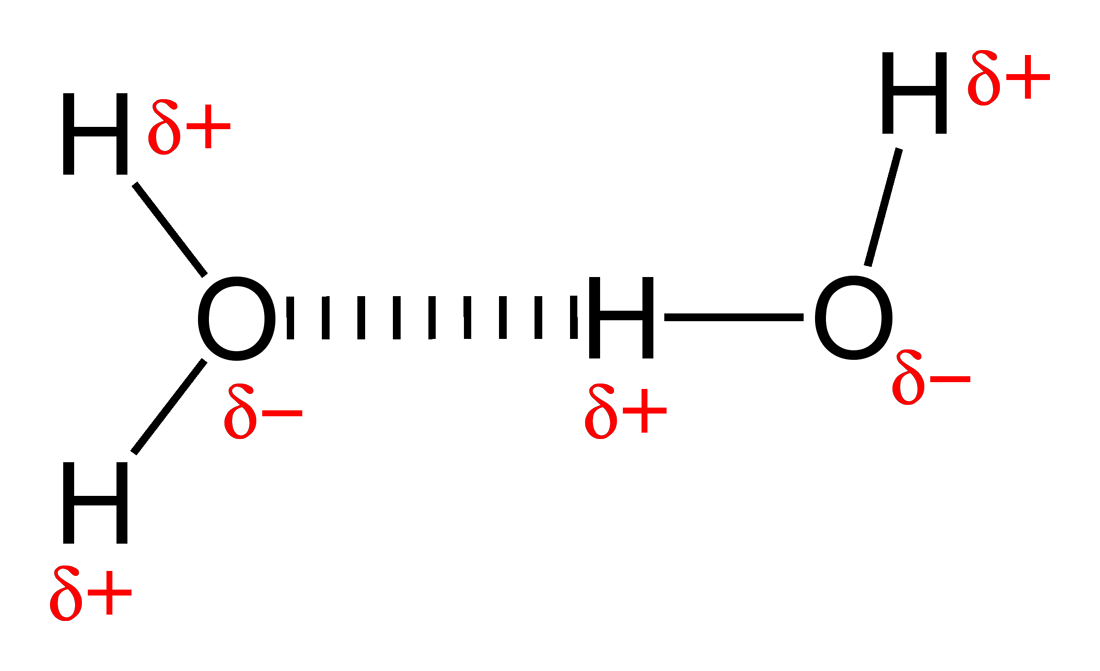
An enthalpy change has four contributions$$\Delta H^\circ=\Delta E^{Molecular}+\Delta H^{\circ,Translation}+\Delta H^{Rotation}+\Delta H^{Vibration}$$The molecular energy $\Delta E^{Molecular}$ is associated with the electrons and nuclei, i.e. chemical and intermolecular bonding, and this is often the largest term.

For example for the reaction $H_2 \rightarrow 2H$ the enthalpy contributions are:$$\Delta H^\circ = 460.2+6.3-2.5-26.4=437.6 \text{ kJ/mol}$$For breaking the hydrogen bond between two water molecules,$H_2O\cdot \cdot \cdot HOH\rightarrow 2H_2O$, the energy terms are$$\Delta H^\circ = 20.5+6.3+3.8-17.6=13.0 \text{ kJ/mol}$$In both cases $\Delta H^\circ$ is positive mainly because it requires energy to break a covalent bond or a hydrogen bond.
Figure 1. The attraction between partially charged atoms in a hydrogen bond is contained in $\Delta E^{Molecular}$ [image source]

Estimating enthalpy changes of chemical reactions
Most chemical reactions are not as simple as $H_2 \rightarrow 2H$ and involve the making and breaking of several bonds.  For example for this reaction there are three double bonds and one single bond in the reactant molecules and one double bond and five single bonds in the product molecule.

Figure 2. The prototypical Diels-Alder reaction where 1,3-butadiene reacts with ethene to form cylcohexene 

To estimate the enthalpy change this reaction you need to know the strengths of CC double and single bonds which are 611 and 347 kJ/mol respectively.  So it requires $3\times 611+347=2180$ kJ/mol to break the bonds in the reactants and you get back $-(611+5\times 347)=-2346$ kJ/mol back when you form the bonds in the products, so $\Delta H^\circ=-166$ kJ/mol is a good estimate of the enthalpy change.

You can find a list of bond strengths here.  The values are given in kcal/mol so you must multiply them by 4.184 to convert to kJ/mol.

Enthalpies of formation
Enthalpies of formation ($\Delta H^\circ_f$, also called heats of formation) can also be used to  estimate $\Delta H^\circ$ for a reaction.  So for the reaction in Figure 2:$$\Delta H^\circ=\Delta H^\circ_f(\text{cyclobutene})-\Delta H^\circ_f(\text{1,3-butadiene})-\Delta H^\circ_f(\text{ethene})$$ You can find enthalpies of formation of many molecules on the web by Googling or you can estimate them using the Molecule Calculator.

Endothermic and exothermic reactions
Reactions for which the enthalpy increases are called endothermic reactions and reactions for which the enthalpy decreases are called exothermic

Test: Is this an endo- or exothermic process?


Creative Commons License
This work is licensed under a Creative Commons Attribution 3.0 Unported License

Thursday, December 27, 2012

Peer instruction question on entropy


Answer the question first here and see the following slides for an explanation


Creative Commons License
This work is licensed under a Creative Commons Attribution 3.0 Unported License

Wednesday, December 5, 2012

Teaching high school students to fold proteins in less than a day


Program

1. The Computational Chemistry Movie

2. Brief introduction to computational chemistry (slides nr 2-6)

3. The Protein Structure Activity using Molecular Workbench

4. Start on the introductory puzzles for Foldit

5. Lunch

6. Four Peer Instruction questions using Socrative (slides nr 7-13)

7. More puzzles on Foldit

8. Tour of the Department


Creative Commons License
This work is licensed under a Creative Commons Attribution 3.0 Unported License.  

Wednesday, October 26, 2011

Tools for the lazy teacher


Here are my slides for my talk at the meeting of the Theoretical Chemistry section of the Danish Chemical Society.

Here are links to the sites and programs I discuss:
Polleverywhere.com (Socrative.com)
The cyclohexane Jmol example
ChemDoodle Web Components demo using Molgrabber
Molecular Workbench model of entropy (link to Molecular Workbench)
ChemTube3D
Avogadro model builder (see also this post on the autoopt tool)
Pen- and Screencasts
Khan Academy
Wolfram-Alpha (see also this post)
Online homework using Peerwise (I recommend the last video on this page)

Update: check out the Molecule Calculator!

Questions?  Leave a comment below!

Thursday, May 26, 2011

Outline Jan's edu-seminar: Using simulation and visualization in chemical education

Here are the main points of my seminar which I give tomorrow:

Chemistry deals with complicated three-dimensional structures and the complex motion of many particles, both of which are usually reduced to static two-dimensional structures on blackboards and Power Point Slides when teaching.  This is one of the things that makes chemistry a "difficult subject".  In the talk I show some examples (listed below) of how this can be overcome using three free software packages called Jmol, Molecular Workbench, and ChemDoodle Web Components.

I discuss four ways of using simulation and visualization when teaching chemistry:

1. Make an e-resource page (for example on Absalon) with links to simulations or visualizations you find on the web.  Examples: the DGU site and Jean Claude Bradley's page.
Try Googling "jmol and xxx" where xx is your topic of interest, such as "inorganic chemistry" or "chirality".  Or look through the library of simulations that come with Molecular Workbench.

2. Use them in lecture. Examples: illustrating energy states and molgrabberOther examples in physical chemistry.

3. Use them in peer instruction.  Examples: cyclohexane and illustrating entropy. See more examples hereSee two videos on peer instruction here.
I use Polleverywhere.com for voting.  It is free for 30 or less students.  I have bought a 1-year license for larger courses.  If anyone at KIKU or COMS wants to use it, contact me for login instructions.

4. On-line quizz or practice pages.  Examples: cyclohexane, chirality, and molgrabber.

If someone in KIKU or COMS is interested in pursuing some of this further, please contact me.  We have money to hire student helpers.

Sunday, May 15, 2011

Peer instruction without clickers

I have written about my first experience with peer instruction over at Molecular Modeling Basics.  Click here to read, and please leave any comments over there.

I have bought an instructors version of polleverywhere.  If anyone at KIKU or COMS is interested in using it, just contact me.

Friday, April 29, 2011

Using clickers in lecture

Today's "educational seminar" (NB: in Danish) will be on the use of clickers and cards in lecture. Here are two videos that serve as a good introduction to the topic.

The first video is only 6 minutes long and is a good place to start. The second is more than an hour long, but much more informative. It is a lecture given by Eric Mazur who is a pioneer in the field.